
Asia market roundup: stability, growth, and the cost of complexity September 16, 2026 What’s new? As political and economic realities...
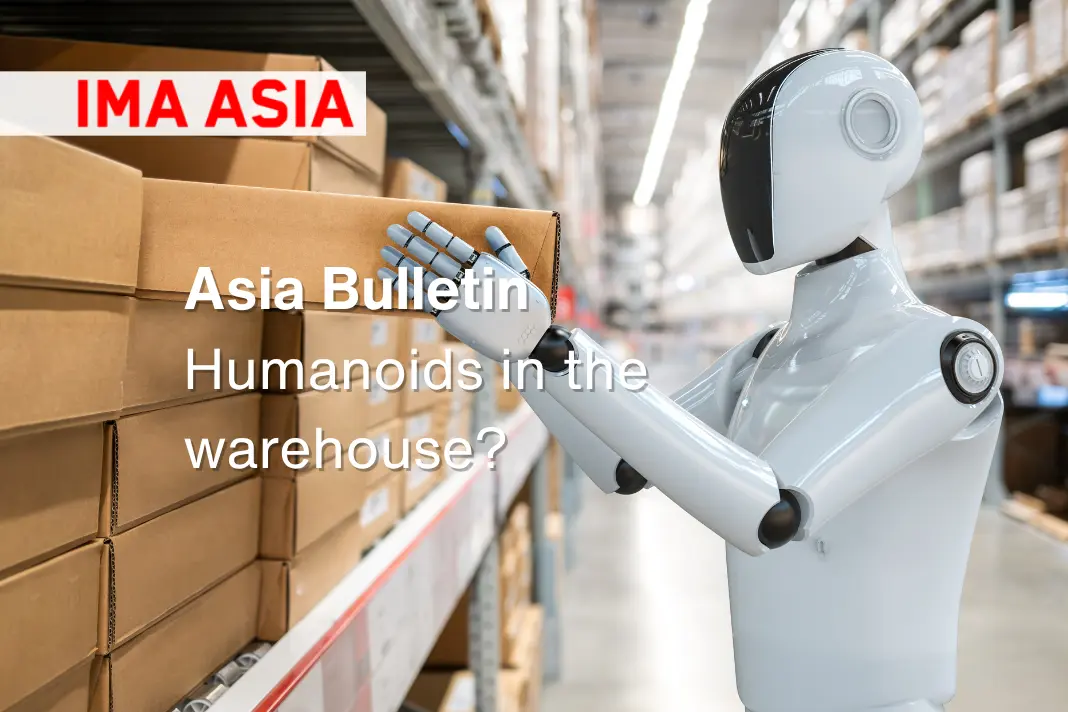
There have been significant breakthroughs in robotics, particularly with robotic hands being paired with AI. I think there needs to be more discussion about how this will shape the way we do business and eventually completely change how we live as a species in the world. These robots can hang paintings on a wall and will be able to repair anything in your house, do all the work in our warehouses and factories, and even in healthcare.
It’s quite the change in the economy and ways of working that will have geopolitical ramifications as well. I see all the buildup of AI capability, plus the new robotics element out there. It’s all coming together really fast – the transformation could happen in three to five years. Are we ready for a world where governments hand out money to people who then buy goods made entirely by efficient machines? (Global logistics firm)
We have eight on-site labs and factories in Southeast Asia, and they are very automated, but do not use robots per se. It’s more that we use AI to optimise formulations for our chemicals. (Global industrial solutions provider)
We use robotics a lot. It started with a massive investment in automated storage and retrieval systems (ASRS) that are locked on tracks inside the warehouse. Not long ago, we started using autonomous mobile robots (AMRs) that are modular and far less expensive. But what we could never replace were the human pickers with manual dexterity to move the boxes by hand.
So far, the persistent constraint has been work requiring human hands with sensitive pressure control.
You ask what my biggest problem is. It is a very good one to have because we are growing rapidly. Right now, we need to ensure we have the right talent to implement these projects, and that talent is hard to find. Maybe, in three years, my problem will be what to do with our employees when I have robots waiting to execute the job.
Once there is mass production of robots with human-like dexterity, I think it is going to be inevitable. Robots work 24 hours a day, never go on strike, never get sick. You know how much you’re going to pay. I expect that these new robots will quickly go into logistics and manufacturing industries, then service industries, and then be used for domestic activities.
First, as China establishes an early lead in humanoid robots, the US is moving to restrict their market access.
Second, innovation rarely travels in a straight line. The most consequential applications may not be the ones businesses are currently planning for.
A Chinese robotics professor said he was stunned by how far robots had advanced in just a few years. His take was that autonomous driving might eventually be unnecessary: a household robot could vacuum, feed the dog, then climb into an old petrol-powered car and drive its owner to the supermarket. China already leads in the production and deployment of humanoid robots. It will be interesting to see how this plays out.
Interested in joining the discussions?
Contact us to learn more.

Asia market roundup: stability, growth, and the cost of complexity September 16, 2026 What’s new? As political and economic realities...

Humanoids in the warehouse? August 12, 2026 What’s new: Advances in robotic hands, machine vision, and AI are bringing humanoid...

Inflation in Asia: managing costs in both directions July 28, 2026 What’s new: The spectre of inflation is hardly new....