
October 9, 2026/
No Comments
The persuaders: Asia CEOs make their case to HQ October 9, 2026 What’s changing? As geopolitical shocks and economic uncertainty compete for attention,...
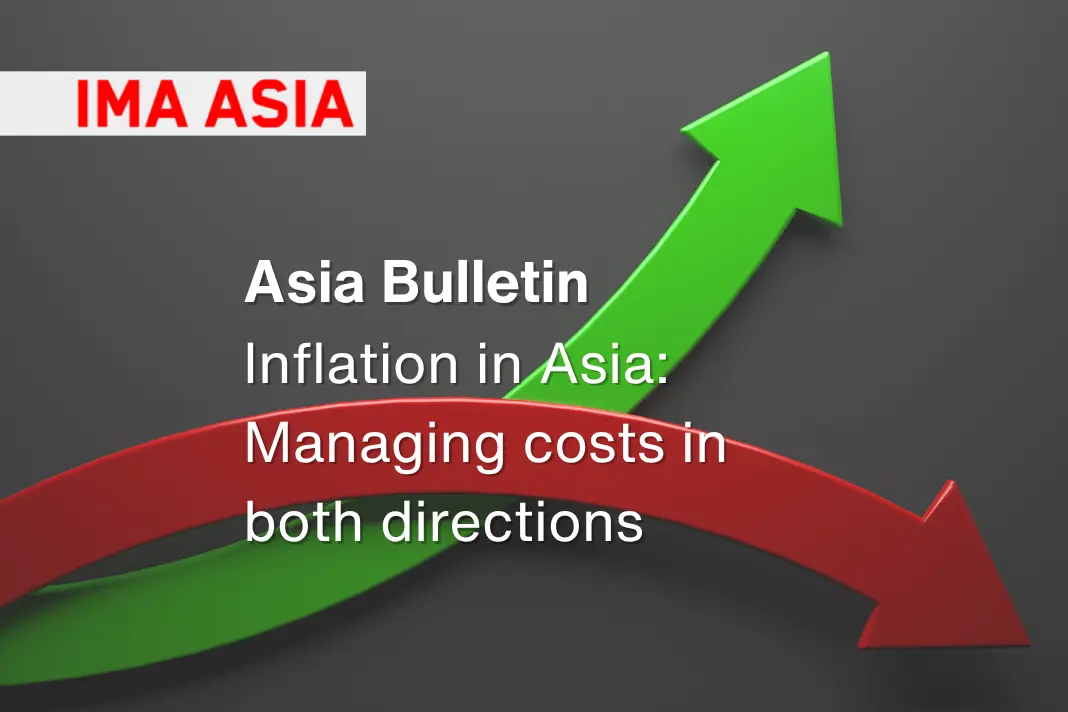
There is a broad challenge for inflation and economic forecasting. Energy prices, physical shortages, futures markets, demand expectations, and geopolitical risk are interacting in ways that are increasingly difficult to interpret in real time. We may need several months of data before we can distinguish a temporary market dislocation from a more persistent shift—and only then begin to shape an appropriate response.
During a recent China Management Forum session, one speaker demonstrated how confusing the inflation picture can be by quoting the US president’s response to US inflation when it breached 4%.
In June, after the US announced 4.2% inflation, Trump said, ‘I love the inflation’. The US is working on a different economic logic not taught in textbooks or business schools.
The remark was characteristically disorienting, but the argument behind it was familiar: Trump assumes price shocks are temporary, driven by war and energy disruption, and will subside once the crisis passes.
In my view, the US is dialling down tariffs because it is very concerned about inflation at home, which is positive for our part of the world. They initiated many Section 301 investigations, but these cannot be implemented immediately, unlike the 10% tariffs under Section 122, which will expire July 24. The US Supreme Court’s verdict to strike down the IEEPA tariffs had a chilling effect. Trade wars could be rekindled, but let’s see.
For export-led Asian economies, the bigger risk is coming from China’s export controls on rare earths. Companies are telling us that the hit from China’s export controls is a bigger challenge than US tariffs.
There’s a structural question: will the inflation regime shift higher in the long run? Instead of targeting 2% inflation, will economies move toward 3% or 4% as the new normal? Will central banks become more tolerant of above-target inflation? That would amount to a significant change.
In the consumer packaged goods industry, growth has come from pricing rather than volume. This trend began with COVID and continued through the Russia-Ukraine war, leading the industry to believe it could survive by relying primarily on price increases.
But there is a limit to what consumers will bear.
Companies now recognise the need to balance price and volume growth—because if consumers begin to walk away from your brand and trade down, you risk long-term losses.
You must address two main consumer segments when inflation hits: one willing to pay for health, quality, or innovation, and another focused on value. Singapore is a very good example. People cook at home rarely; a high percentage of meals are consumed outside. As prices rise, value consumers will shift from a $5 coffee to a $1 coffee.
But when people start eating at home to save money, they still want quality ingredients to replicate the eating-out experience. In my experience in coffee and earlier in the sauces industry—after COVID, people began buying more premium products as they reduced out-of-home consumption.
This can mean that, if there is flexibility in spending, inflation does not wipe out premiumisation or the middle tier.
Some consumers will down-trade to even cheaper brands, while premium consumers may shift to mainstream brands, and those who typically buy out-of-home may move into the premium segment.
One executive described this in terms most people can relate to.
We often use the term ‘squish, squeeze, and swap’ to describe consumer behaviour—like what you do with toothpaste as it runs out. Once you’ve squished and squeezed the last bit out, if you still can’t afford more, you swap to a lower-priced brand. This is typical during periods of inflation.
But others are concerned that inflation will hit value consumers hard, who do not have the flexibility of discretionary purchases.
I expect H2 will see an uptick in inflation, especially in food and electronics. There are only a handful of countries powering AI. Apple has increased prices due to chip shortages, and this is happening everywhere in compute. For a company like ours, we can procure new computers every five years instead of our usual four. Waiting has a limited impact on our productivity.
But in Asia, it is not so easy for many people to simply defer or buy cheaper food or fuel for transportation. People must eat. It might be that some of us will have to consider salary increases because, in the end, everything is going up.
For example, China’s recent export controls on tungsten have driven up prices for manufacturers. For one business leader, the issue is particularly knotty.
The majority of the global tungsten supply comes from China. In the last four months or so, I have done more research on this topic than any during my academic days. Tungsten is used in everything from chips and electronics to explosives and defense shields. The US inventory is already quite low due to the war. And China controls the supply.
If a raw material is not available because it’s controlled by China, then countries will innovate to find a solution. Lithium batteries are a good example. China dominates lithium processing and battery manufacturing, but now there is a new generation of batteries that use sodium, which is abundant.
While sodium batteries may be less efficient than lithium batteries, if people don’t have access to lithium, they will invest time and use AI to improve it. Progress comes from constraints, and necessity is the mother of invention.
The value of energy: Executives also shared concerns about how to assess the value of oil when price signals no longer line up.
Oil is still one of the key drivers of the global economy, but the oil market has become much harder to read. At one point during the crisis, some physical crude prices were trading around $140 a barrel—roughly $30 to $40 above later-dated futures—because buyers were paying a premium for immediate supply. Yet prices subsequently fell back toward $70, despite major disruptions to production, shipping, and millions of barrels a day of regional refining capacity.
There are several possible explanations: markets may be anticipating a recovery in supply, demand may be weakening, and strategic reserves and alternative producers may be filling some of the gap.
Whether inflation is 5% or 10%, psychologically, we all can operate reasonably well in an inflationary environment because there is already a mindset that costs will go up. It’s not a problem. It is the other side of the equation that is difficult to price in.
If commodity prices go down, we lose out. Big companies all hedge and know their costs three months out to secure availability. So, we are at a huge disadvantage. Inflation is not a problem for big companies, but deflation is, which will disrupt the flow of dividends.
The current level of AI investment is excessive and unrealistic. From a practical standpoint, even if all the announced investments went forward, there wouldn’t be enough resources or power to run the required data centres. At some point, there will have to be a correction.
Some see history repeating itself.
I’m convinced AI is a transformative technology, similar to the internet in 2000. After the dot-com bubble, there was a correction: the less useful applications disappeared, and the internet’s real value endured. I expect the same will happen with AI—the hype will fade, and only sustainable uses will remain.
However, this correction will first impact the global economy. With so many massive investment figures being thrown around—hundreds of billions of dollars—eventually, the bubble will burst. In short, we are looking at bumpy days ahead.
We’re at a fork in the road. The outcome remains uncertain—energy and resource scarcity could push inflation higher, but competing factors exist. The challenge of energy costs clearly points toward a longer-term trend of higher inflation. On the other hand, if productivity gains outpace wage increases, inflation may not need to rise as much for companies.
The old rules of inflation still apply. But in an age of fractured globalisation and AI, shocks are arriving more frequently, supply is less able to adjust, and prices no longer move together.
Interested in joining the discussions?
Contact us to learn more.
The persuaders: Asia CEOs make their case to HQ October 9, 2026 What’s changing? As geopolitical shocks and economic uncertainty compete for attention,...
Currency hedging & Inflation predictions September 17, 2026 What’s changed: Asia CEOs and managers discussed how they are managing a...
Asia market roundup: stability, growth, and the cost of complexity September 16, 2026 What’s new? As political and economic realities...